
Written by Xinong Xu, intern
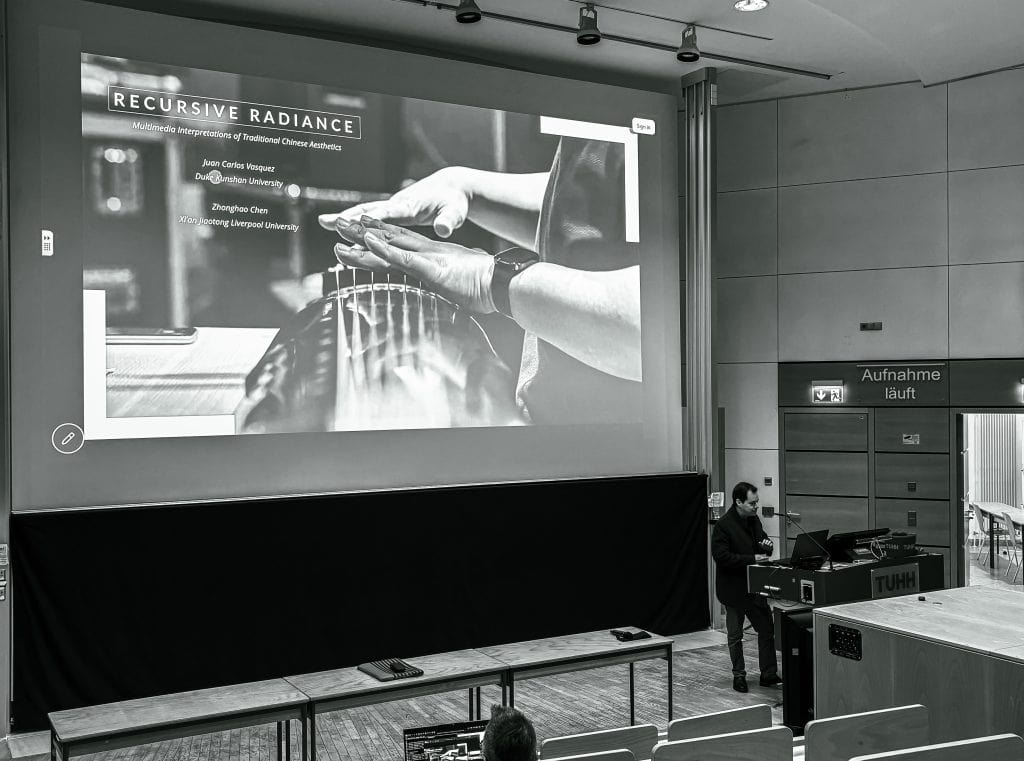
Duke Kunshan University faculty member Juan Carlos Vasquez, Assistant Professor of Computation and Design, presented his research Recursive Radiance: Multimedia Interpretations of Traditional Chinese Aesthetics at the International Computer Music Conference (ICMC) 2026 in Hamburg, Germany from May 10 to 16, 2026. In addition, Vasquez’s fixed media composition The Eternalist Paradox was performed during the conference’s curated concert program.
The research was developed across DKU and XJTLU, with fieldwork conducted at Tai Lake, China. ICMC Hamburg 2026 is hosted by the Hamburg Institute of Technology and is part of one of the most prestigious peer review venues in the global field of computer music. The theme of ICMC is “Innovation, Translation, Participation”, and its contributions are selected through an international peer review process. The conference program includes paper conferences, installations, listening rooms, and a carefully planned concert series.
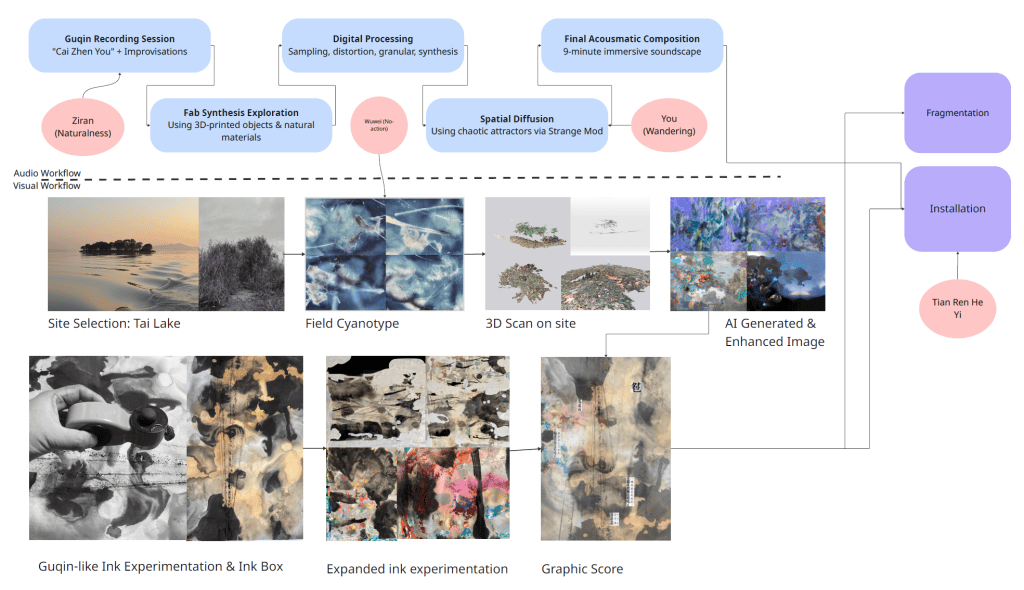
The research, developed in collaboration with a researcher from Xi’an Jiaotong-Liverpool University (XJTLU), explores how traditional Chinese philosophical and aesthetic principles—especially those rooted in Daoist thought—can inform and reshape contemporary multimedia and electroacoustic composition. Centered on the guqin, one of China’s oldest instruments, Recursive Radiance transforms a traditional piece (Cai Zhen You) through digital processes, spatial audio diffusion, and generative visual scores.

Rather than treating Chinese aesthetics as exotic source material, Recursive Radiance engages deeply with concepts such as Ziran (naturalness), You (wandering), and Tian Ren He Yi (the unity of humanity and nature) as structural and compositional principles. The result is a nine‑minute immersive soundscape accompanied by graphic scores that function simultaneously as artworks and as notation. The methodology itself is interdisciplinary: guqin performances were processed using 3D‑printed objects and natural materials; spatial diffusion was achieved via chaotic attractors; and the visual component was developed through ink experimentation on Xuan paper, field cyanotypes at Tai Lake, and AI‑assisted image generation—all mapped explicitly onto Daoist aesthetic frameworks.
On the project’s cultural positioning, Vasquez notes: “Recursive Radiance is not about representing Chinese tradition—it’s about thinking with it. The philosophical frameworks embedded in guqin practice offer compositional logic that is fundamentally different from Western models, and that difference is generative.”
Regarding the multimedia methodology, he states: “The visual and sonic components aren’t illustrating each other. They’re running parallel creative trajectories that emerge from the same philosophical source. The recursion in the title is literal: each layer reflects and transforms the others.”
On DKU’s role in this research, Vasquez highlights: “Being embedded in China gives this work a different kind of grounding. The fieldwork at Tai Lake, the access to living guqin traditions, the conversations happening across institutions here—none of that is incidental. It’s constitutive of what the research is.”
The project’s acceptance at ICMC, coupled with the concert performance of The Eternalist Paradox, signifies a dual contribution: both as scholarly research and as artistic practice. This achievement places DKU at the heart of an international dialogue on how Asian institutions and artists are redefining the field of computer music—transcending Western-centric paradigms and advancing more culturally rooted and geographically diverse approaches to the practice.