Written by Xinye (Josie) Zhou, intern
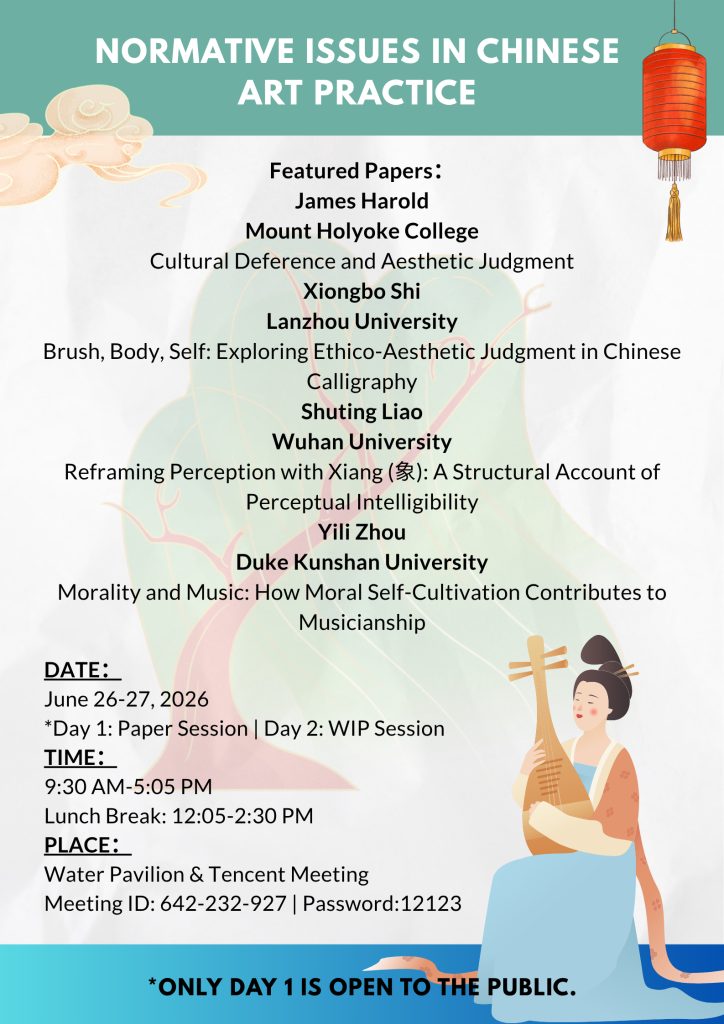
On June 26–27, 2026, a small academic workshop titled “Normative Issues in Chinese Art Practice” was held at the Water Pavilion on the Duke Kunshan University campus and also streamed online via Tencent Meeting. Organizer Yili Zhou, Visiting Assistant Professor of Philosophy at Duke Kunshan University, gathered scholars working at the intersection of aesthetics, ethics, and Chinese philosophy to ask how Chinese artistic practices, such as calligraphy, music, and aesthetic perception, involve ethical standards, cultural values, and forms of judgment.

The invited speakers were James Harold, Andrew W. Mellon Professor of Philosophy at Mount Holyoke College; Xiongbo Shi, Associate Professor at Lanzhou University; and Shuting Liao, PhD in Philosophy, Wuhan University. The event spanned two days: Day 1 offered a public paper session, and Day 2 focused on work-in-progress presentations, combining formal talks with plenty of discussion.
During the first day, James Harold looked at cultural deference in aesthetic judgment, particularly the tension between respecting culturally specific norms and preserving autonomy in personal judgment. Xiongbo Shi discussed ethico-aesthetic judgment in Chinese calligraphy, showing how bodily metaphors, embodied practice, and moral character shape traditional calligraphic evaluation. Shuting Liao presented an account of xiang (象) as a structural framework for perceptual intelligibility, suggesting that Chinese aesthetic and philosophical concepts can enrich contemporary debates on perception. Yili Zhou’s paper argued that moral self-cultivation may contribute to musicianship.

The second day’s work-in-progress session extended these conversations in a more exploratory format. James Harold raised the relation between the artist and ren (仁), questioning whether an artist’s moral character should affect our engagement with their work. Xiongbo Shi tackled the ontology of Chinese calligraphy as art. Shuting Liao shared ongoing projects on aesthetic judgment and yin (音), exploring how sound becomes ordered, patterned, and normatively intelligible. Yili Zhou compared lintie (临帖) in Chinese calligraphy with score-following in classical music performance, asking how fidelity to an authority can become a channel for self-expression.

The workshop was small by design, creating a warm, discussion-oriented space for scholars from diverse backgrounds to think together about Chinese art practices and their philosophical significance. It also helped strengthen connections between DKU and other institutions working on philosophy of art. As Zhou put it: “This workshop grew out of my interest in how Chinese art practices can help us rethink the relationship between aesthetic value, moral cultivation, and normativity. I had a really wonderful time discussing Chinese aesthetics and the broader relationship between ethics and art, in such a warm but intensive space with scholars who share similar academic interests in DKU’s beautiful summer setting.”