
Written by Xinong Xu, intern

The Yingxian Wooden Pagoda, the oldest and tallest surviving fully wooden pagoda in the world, has stood for nearly a millennium since its completion in 1056. Officially known as the Sakyamuni Pagoda of Fogong Temple, this Liao-dynasty structure rises 67.31 meters with a base diameter of 30.27 meters, weighing more than 7,400 metric tons. Built entirely with mortise-and-tenon joinery without the use of a single nail, it has endured centuries of earthquakes and two wartime artillery strikes in 1926 and 1948. Designated in 1961 as one of China’s first National Key Cultural Relics Protection Units, the pagoda yielded the Khitan Tripitaka scrolls and a Buddha tooth relic in 1974. By 2004, the Shanxi Provincial Bureau of Cultural Relics reported significant structural deformation: the tower leaned 65 centimeters to the northeast with a cumulative compression of 88 centimeters. Over the past two decades, conservation practice has advanced through surveying, scanning, monitoring, and targeted maintenance, but major renovation methods remain subject to further government deliberation and approval. The pagoda and related Liao wooden structures were also submitted by China to UNESCO’s Tentative List in 2011. While this national treasure in Yingxian County, Shanxi Province, is renowned in architectural history, religious studies, and cultural heritage conservation, its shifting meanings in local social memory and everyday life have received little scholarly attention. A faculty-student collaborative research project at Duke Kunshan University is now addressing this gap.

Titled From “Buddhist Stupa” to “Cultural Relic”: Changing Meanings of the Yingxian Wooden Pagoda in Local Memory (1949–2026), the project is led by Kent Cao, Assistant Professor of Art and Archaeology at Duke Kunshan University, and Zhixian Zhao, a junior undergraduate student majoring in Global China Studies and a native of Yingxian County. The study traces the pagoda’s changing social identity—from a sacred site of Buddhist ritual practice to a nationally designated heritage monument—examining how this transformation has been registered in the lived memories, oral narratives, and daily practices of multi-generational local residents. The core inquiry addresses a significant gap in existing scholarship by foregrounding local social history, cultural memory, and everyday experience, creating a timely opportunity for a complementary, community-centered study.
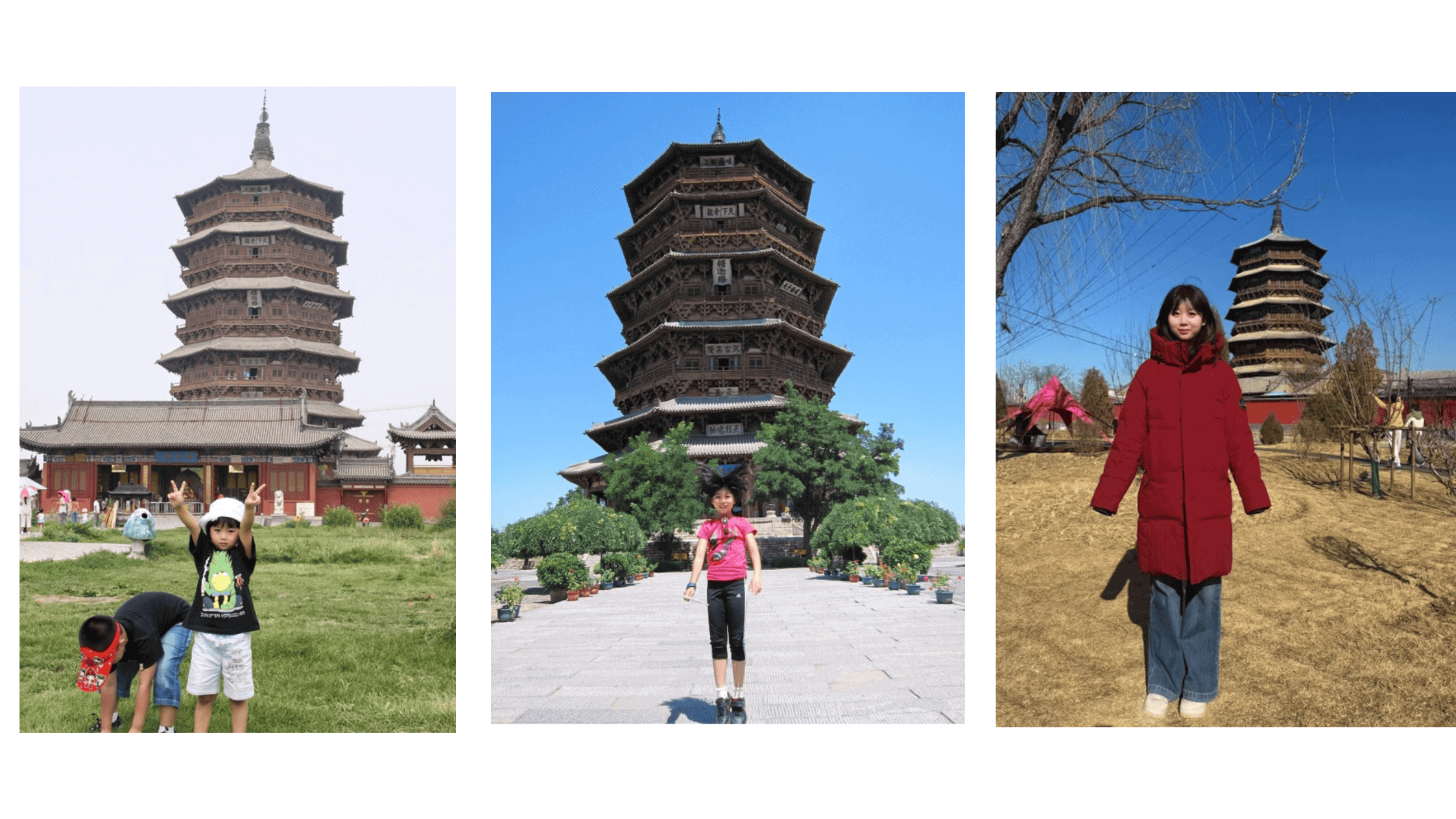
Zhixian Zhao, who grew up in Yingxian, recalls a time when the pagoda was accessible and tactile. “Over a decade ago, people could still climb the narrow wooden stairs and feel the ancient timbers beneath their feet. Today, visitors are confined to the ground floor and can only look up from a distance. This physical restriction has gradually created a sense of distance—not just for tourists, but for us locals as well,” Zhao observes. In recent years, as younger generations have migrated to cities for employment, the streets around the pagoda have grown noticeably quieter, with the elderly constituting the majority of those who remain. “Most of those who remain are the elderly. I have listened to their stories since I was young, which carry abundant firsthand memories, folk tales, childhood anecdotes and informal perceptions of the pagoda that are rarely documented in official archives or architectural scholarship. These memories are fading, and with them, an important part of our local history. Through this research, I hope to use my position as a native, alongside the academic guidance and support of my Professor Kent Cao, to document and preserve these valuable vanishing memories for future generations,” Zhao explains.
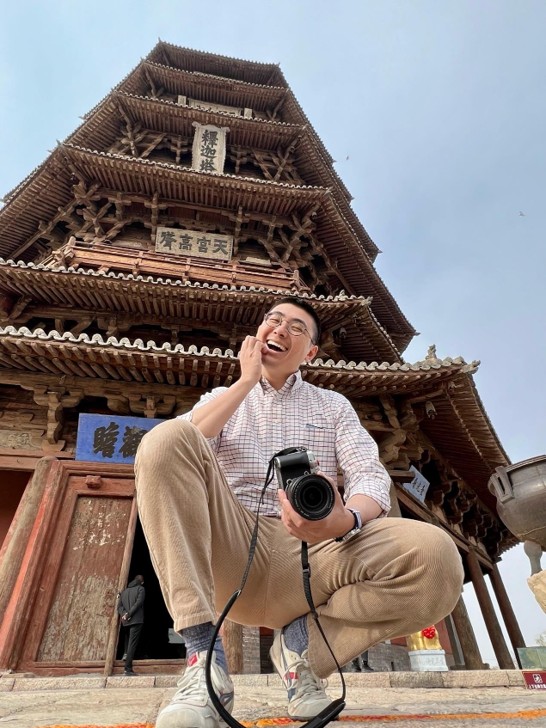
Professor Cao first visited the Yingxian Wooden Pagoda in 2022 during a field trip examining Eastern Zhou bronzes from the Jin state at Hunyuan. He spent four hours beneath the structure, examining its calligraphy and architectural details. “I was struck by its scale, its vertical presence, and the layered history embedded in its timbers and inscriptions. I spent four hours standing beneath the pagoda reading calligraphy and studying architectural detail. These hours convinced me that the pagoda’s material presence and the community’s living memories are inseparable. This project aims to document those memories before they fade, and to place local voices at the center of heritage scholarship,” Cao reflects.
The project employs three mixed qualitative methods: semi-structured oral history interviews, ethnographic participant observation, and documentary archive analysis. The historical scope spans from 1949 to 2026, with key fieldwork windows scheduled for Summer 2026 and Winter 2026–2027. The project is expected to conclude by April 2027. This faculty-student collaborative research has clear academic, practical, and social value, filling a long-existing gap in Yingxian Wooden Pagoda studies, which have mainly focused on architectural structures, religion, and restoration techniques while largely ignoring community perspectives and cultural memory. The project creates effective dialogue between official national heritage narratives and real-life experiences and memories of local residents.
Professor Cao notes that “existing scholarship on the pagoda has predominantly focused on architectural structures, religious functions, and restoration techniques, while largely overlooking community perspectives and cultural memory. Our research seeks to create an effective dialogue between official national heritage narratives and the lived experiences and memories of local residents, offering a more comprehensive understanding of this millennial monument’s contemporary significance.”
Upon completion, the project will yield multiple tangible outcomes, including a peer-reviewed academic journal article, an academic conference presentation, a student capstone thesis, and a campus multimedia exhibition alongside a scholarly roundtable at the DKU Humanities Research Center. This research is supported by the DKU Undergraduate Summer Research Scholars (SRS) Program, which enables students to participate as “full collaborators” in faculty-led research projects. The program emphasizes four core competencies: collaborative problem-solving, integration of research and practice, clear communication, and independent thinking with creativity. Through this engagement, students receive comprehensive training from project conceptualization to completion, while ensuring that scholarly inquiry remains closely tied to community benefit.
The research team has explicitly committed to ethical and reciprocal research principles, with plans to organize oral history archives and provide bilingual research results to the local community, so as to preserve vanishing intangible oral memories. “This is not merely an academic exercise but a commitment to preserving an important part of our local heritage,” Zhao affirms.
As the project moves forward, it promises to contribute a distinctive and invaluable humanistic perspective to the conservation of the Yingxian Wooden Pagoda and the intergenerational transmission of local cultural memory, while simultaneously advancing a more inclusive and community-grounded approach to heritage scholarship in China and beyond.