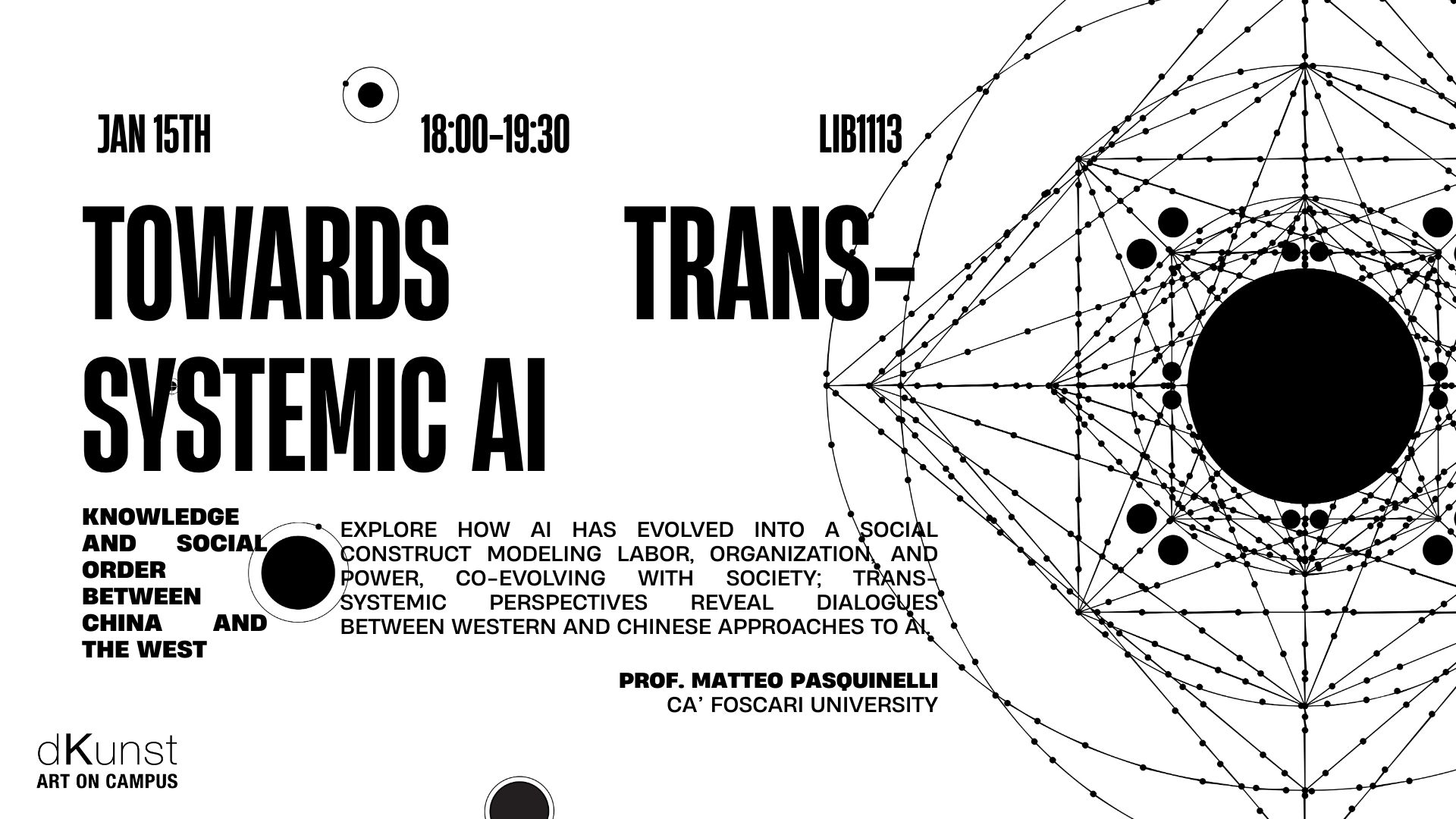
AI models have left their infancy as techniques of pattern recognition and, over the span of a decade, have become vast representations of entire cultural and political systems. In the West, through a long process that began with Charles Babbage in the industrial age and continued with psychometrics in the twentieth century, machine intelligence emerged less from attempts to imitate biological or individual intelligence than from efforts to formalize the intelligence of the division of labour and social organization. AI has been a social construct since its inception, and its contemporary architecture—vast datasets coupled with large models—confirms this thesis. Contrary to technovitalist imaginaries, AI is not an autonomous entity but a ‘model’ of social structures in a continuous and dialectical relation with social structures. AI and society co-evolve through a process in which the social division of labour remains the central nexus. The notions of trans-systemic society and trans-societal system (Wang Hui 2004/2023) can help illuminate these dynamics and provide a framework for dialogue between AI with Chinese and Western characteristics.
Matteo Pasquinelli is Associate Professor in Philosophy of Science at the Department of Philosophy and Cultural Heritage of Ca’ Foscari University in Venice where he is coordinating the ERC project AIMODELS (unive.it/aimodes). His book The Eye of the Master: A Social History of Artificial Intelligence (London: Verso, 2023) won the Deutscher Memorial Prize 2024 and has been translated in 15 languages. It will be published in Chinese in January 2027.