
Duke University, April 16–17, 2026 | By Qirui Lei – Harmony Lab
From April 16 to 17, 2026, the Harmony Lab participated in a two-day workshop at Duke University exploring the concept of harmony across Greek and Chinese philosophical traditions. The event brought together scholars working on Plato, Aristotle, early Chinese thought (Confucian and Daoist), and contemporary comparative philosophy.
Day One: Self-Knowledge, Family, and the Roots of Harmony
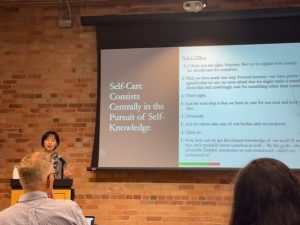
The workshop opened with Wenjin Liu’s presentation on self-care and self-knowledge in Plato. Liu argued against the view that self-care presupposes self-knowledge, proposing instead that self-care is fundamentally realized through the pursuit of self-knowledge itself. “The best human life does not require fully possessing virtue and knowledge,” Liu noted, “but is achieved through ongoing self-care and self-knowledge, an essentially interpersonal and dialogical process.”
The morning continued with a panel on women and family in Chinese philosophy featuring Yong Li (Sun Yat-sen University), James Miller (Duke Kunshan), Qin Liu (Wuhan, via Zoom), and Hwa Yeong Wang (Duke Kunshan). Yong Li challenged the contemporary Confucian claim that the family is a universal solution for meaning in life, while James Miller used the historical case of Daoism and Buddhism’s introduction to China to argue that Chinese understandings of family have always been flexible rather than fixed. Qin Liu, drew on Neo-Confucian metaphysics to propose that “man” and “woman” are fluid “temporal positions” rather than fixed essences, and Hwa Yeong Wang turned to contemporary Korea’s fertility crisis to argue that ritual (li), not just abstract principles, must be the site of reform for gender equality.

Mitzi Lee (Colorado-Boulder) examined whether justice is a natural virtue in Aristotle despite its connection to conventional laws, highlighting his view that humans possess a natural tendency to form political communities. Chris Fraser (Hong Kong) analyzed “harmony” (和) as a normative ideal in Zhuangist thought, tracing its range from musical concord to social peace. “The skillful practice of dao involves achieving a state of harmony with one’s circumstances,” Fraser explained, “enabling the agent to proceed smoothly along the way.” Emily Fletcher (Wisconsin-Madison) discussed two educational stages in Plato’s Republic: early musical training that cultivates psychic harmony, and later mathematical education that turns the soul toward the Forms. “The first stage operates through non-cognitive processes,” Fletcher observed, “shaping the young guardians’ souls almost environmentally.”

Day 2: Friendship, Dynamism, and the Models of Virtue
Day two began with Dimitri El Murr (ENS) challenging the conventional division that assigns eros to Plato and friendship (philia) to Aristotle. El Murr argued that friendship plays a crucial role in maintaining unity in Plato’s ideal city, operating across class boundaries through education and shared practices rather than coercion.
Justin Tiwald (Hong Kong) explored the dynamism of harmony in Confucian virtue theory, drawing on Zhu Xi’s analogy of the four virtues as seasons in cyclical harmony. Tiwald identified three constraints on this dynamism: intransigent facts of human nature, the specific medium of harmony (the life-giving process of sheng sheng), and the constant measure provided by discretionary judgment (quan).

Rachana Kamtekar (Cornell) contrasted two Platonic models of virtue: the musical attunement model from the Republic and the puppet-string model from the Laws. While the attunement model describes justice as a harmonious condition of the soul, Kamtekar noted, “it does not fully address motivation for virtuous action”—a gap the Laws puppet model begins to fill by adding causal mechanisms linking psychic dispositions to action.
The workshop concluded with a closing panel featuring Liu, David Wong (Duke), and Iris Jing Hu (Concordia), followed by a tour of Duke Gardens.

Reflections from the Harmony Lab
Qirui Lei (Research Assistant): For me, the most striking takeaway was how differently harmony operates in the two traditions and how seeing them side by side make me learned things I hadn’t even realized and thought. I got the new understanding that harmony is not about reaching a static balance, but about skillfully adapting to circumstances. Turn to Prof. Rachana Kamtekar’s discussion of Plato’s musical attunement, where harmony is literally a mathematical ratio in the soul. But Prof. Hwayeong Wang’s presentation also provide new perspective for me. Her point that we must reform ritual rather than bypass it made me realize harmony isn’t just about individual skill or soul-states. When many Korean women are still trapped by family rituals despite legal equality, we can see how ‘harmony’ can function as both liberation and constraint. Walking through Duke Gardens that afternoon, I realized the discussion itself had been a kind of harmony, not agreement, but enough difference to keep everyone thinking.
Original source comes from: https://sites.duke.edu/dkuhumanities/workshop-report-varieties-of-harmony-in-greek-and-chinese-philosophy/